


RESEARCH SPOTLIGHT
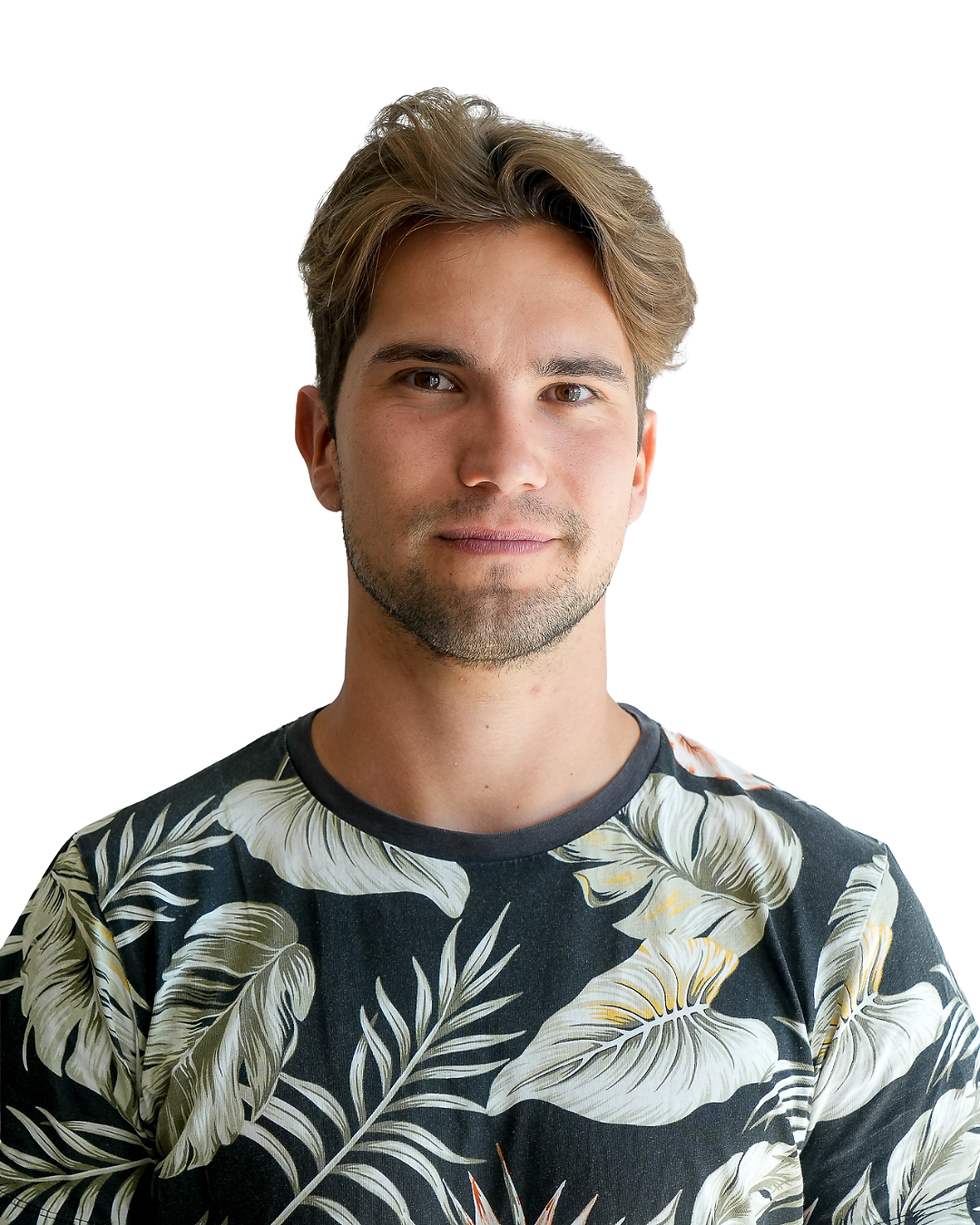
Hi, I am
Sándor Battaglini-Fischer

HOST INSTITUTE
CSIC
PROJECT TITLE
Brain-inspired Computing based on Photonic Oscillators
KEY WORDS
Recurrent Neural Networks (RNNs), Oscillators, Information Processing, Delay-Coupled Dynamical Systems, Brain-inspired Learning
RESEARCH AIM
My research aims to uncover the principles by which delay-coupled oscillator networks learn and process temporal information, and translate these into brain-inspired photonic hardware so that the next generation of AI systems can move beyond energy-intensive digital computers toward fast, efficient, and physically embodied intelligent machines.

RESEARCH OVERVIEW
The brain is remarkably fast and efficient at processing information. While digital computers have their advantages, they are fundamentally limited by their rigid architecture, high energy consumption, and inability to learn flexibly like biological systems do. This raises the question: what if instead of forcing computers to extract learning behaviour out of hardware that wasn't built for it, we built physical systems that work like the brain from the ground up?
This project takes inspiration from some of the brain's key ingredients: neurons firing in rhythmic oscillations, communicating through delayed connections, and self-organizing into networks that learn. By understanding how these ingredients together enable information processing and memory, we can then ask how to recreate them in the physical world, for example using lasers.
RESEARCH CHALLENGE
How do oscillations, delays and learning rules interact to enable brain-like computation, and can these principles be implemented in physical photonic systems?
RESEARCH INNOVATION
(1) The end-to-end pipeline: from brain-inspired principles, through computational models, to physical implementation, rather than treating these as separate research questions. (2) using Stuart-Landau oscillators as a model that sits at the intersection of neuroscience, dynamical systems, and laser physics. (3) simultaneously optimising both coupling weights and time delays, most learning frameworks only tune weights.
RESEARCH IMPACT
The open-endedness. Because the topic connects various cutting-edge areas of research, the outcome and significance for future technologies and research is not immediately clear. This makes it daunting at times, but also extremely exciting!
RESEARCH SUMMARY
My project transfers concepts from cognitive and computational neuroscience to brain-inspired photonic computing. Using autonomous oscillatory dynamics, recurrent and delayed connections, emergent computation, and neural representations, with tools from dynamical systems, control theory, and statistical learning theory, I investigate how brain-inspired networks perform information processing and support short- and long-term memory. A central focus is the simultaneous optimisation of coupling weights and inter-node delays. Beyond task performance, key aspects include robustness against input and system noise, heterogeneity, parameter drifts, and node failure. I further study learning rules enabling recurring temporal patterns for information coding and memory, examining the consistency, specificity, and versatility of different architectures. The overarching goal is to identify which delay-coupled topologies and learning rules best mimic brain networks for temporal pattern-based processing and storage. These insights will guide novel optical neural network implementations, validated experimentally where possible.
RESEARCH VISUAL

RESEARCH JOURNEY
RESEARCH SECONDMENT
VLC Photonics, Spain (2 months) & Université libre de Bruxelles (ULB), Belgium (2–3 months)
During my secondments at VLC Photonics, Spain, and Université libre de Bruxelles (ULB), Belgium, I will strengthen both my practical and theoretical expertise in photonic computing. At VLC Photonics, I will receive hands-on training in photonic integrated circuit (PIC) design while contributing to optimisation challenges and developing a strong foundation in photonic circuit design. At ULB, I will explore backpropagation-free learning methods and contribute to the development of a mathematical framework for optimisation without backpropagation, expanding my understanding of alternative machine learning approaches.
LEARNING GOALS
I am particularly looking forward to collaborating with researchers from different disciplines and institutions, exchanging ideas and expertise while gaining new perspectives on neuromorphic computing.
RESEARCH BENEFITS
These secondments will allow me to bridge theory and practice by gaining experimental insight into the real-world applications of my research while deepening my mathematical understanding of the theoretical concepts that underpin my work.
CAREER DEVELOPMENT
These secondments will broaden my understanding of the neuromorphic computing landscape, providing valuable insight into both academic and industrial career pathways while helping me build the skills and perspective needed for my future career.
MORE THAN PHD
Why did you decide to join POSTDIGITAL+ ?
I joined POSTDIGITAL+ because of its cutting-edge research focus, the opportunity to build an international professional network, and the excellent career prospects it offers during and after the doctorate.
What do you think is the biggest advantage of being part of the International Doctoral Network?
The greatest advantage is the opportunity to build meaningful professional connections while benefiting from collaboration, diverse perspectives, and the support of an international research community.
What skill have you developed the most so far?
Throughout my PhD, I have strengthened my ability to independently plan and manage research while developing my collaboration, presentation, and networking skills through international conferences and research activities.
What are your career ambitions after completing your doctorate?
After completing my doctorate, I hope to continue my research career in either academia or industry. In particular, I am interested in opportunities within machine learning or neuroscience-focused research, where I can continue contributing to interdisciplinary innovation.
What inspired you to pursue this research Area?
Our world is increasingly dependent on computing, and this reliance will only continue to grow. At the same time, there is still enormous untapped potential in understanding how the brain performs computation. The intersection of these fields is both fascinating and highly important. The mathematical frameworks used to study optimisation and complex dynamical systems provide elegant tools for exploring these challenges, and combining these methods with neuroscience and computing strongly aligns with my academic interests and background.
What surprised you most since starting your PhD?
One of the biggest surprises has been the importance of listening to different perspectives. In such a rapidly evolving research field, there is rarely a single correct answer, and researchers often approach the same problem from different viewpoints and areas of expertise. This has shown me the value of having multiple supervisors, being part of an international network such as POSTDIGITAL+, and working within a diverse research community. It has also reinforced the importance of persistence, as research often involves considerable trial and error before meaningful results are achieved.